 Sign in

The Inheritance
C1 · Family Drama · 5 min
The Inheritance
C1 · Family Drama · 5 min
Exercises
Tap any word to see what it means. In bold, the key words of this reading. With the keyboard: arrows to move and Enter to open.
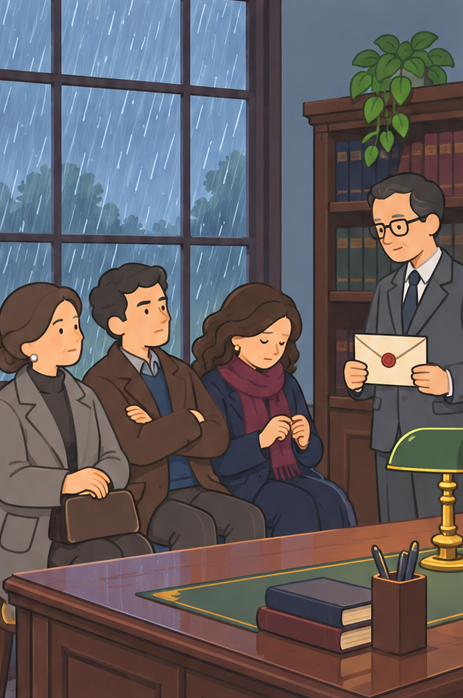
The notary's office smelled of old paper and lemon polish, and the rain outside was so fine that it seemed to hang in the air, rather than fall. Beatriz, Mateo, and Iris sat in a row, like children waiting outside a headmaster's office. They had not been in the same room since the funeral, and none of them had the slightest idea what to say.
The notary, a precise man in a gray suit, put on his glasses and explained that the will of Anselmo Varela had been made six years earlier and had never been changed. He read that the savings would be divided equally among the three of them. He read that the apartment would go to Iris, who had lived nearby and had cared for their father in his last two years. Beatriz nodded. It was fair, she thought, and more than fair.
"Finally," said the notary, "to my son Mateo, I leave the contents of garage number seven at the Ribera storage depot, together with the key that opens it." He slid a small brass key across the desk. Mateo looked at it as if it were an insult. "A storage unit," he said, with a thin smile. "Twenty years of silence, and he leaves me a storage unit." Iris opened her mouth, and then closed it.
If their father had spoken to him earlier, Mateo thought, he wouldn't be sitting here, carrying a key he did not want. The old quarrel had been about something stupid, a motorcycle they had been rebuilding together when Mateo was sixteen, and about a word that neither of them could take back. Mateo had left home that summer, and had only returned for holidays, as a guest who spoke to everyone at the table except his father.
He drove to the depot alone, that same afternoon. Garage seven was at the end of a row of identical doors. The key turned easily, as if somebody had oiled the lock. Inside, in the gray light from the open door, there was a shape under a dust sheet. He pulled the sheet away, and for a moment, he forgot to breathe.
It was the motorcycle. It was a 1974 machine, black and silver, the one that had been a heap of parts on the garage floor twenty years ago. Now, every piece was in its place: the chrome gleamed, the leather seat had been replaced, and the small dent on the tank, which Mateo had made with a hammer at the age of sixteen, had been carefully left alone. Taped to the handlebars, next to a small ignition key, there was a note in his father's slow handwriting: "It runs. I could not ride it without you. It is yours when you are ready."
Mateo sat down on the concrete floor. For a long time, he did not move. If he had come a year earlier, he thought, they could have ridden it together. If he had written a single letter, it might have been different. He stood up, put his hand on the seat, and then he put the small key in the ignition. The engine coughed once, caught, and settled into a deep, steady rumble that filled the little garage.
It ran perfectly, and that was the hardest thing. He sat there, with the engine running and the door open on the rain, and he allowed himself, at last, to cry for the first time in twenty years.