 Sign in

The Maya City of Tikal
A2 · History & Legends · 3 min
The Maya City of Tikal
A2 · History & Legends · 3 min
Exercises
Tap any word to see what it means. In bold, the key words of this reading. With the keyboard: arrows to move and Enter to open.
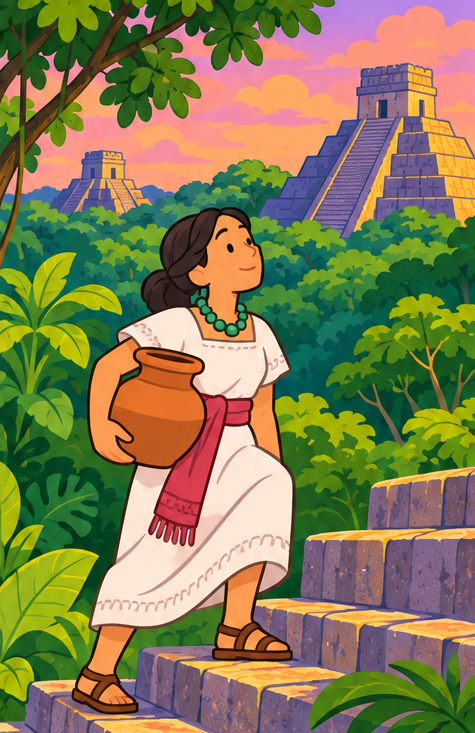
Imagine a city in the middle of the jungle, with tall stone temples and thousands of people. That city was Tikal, in the north of Guatemala, in the region called Petén.
Tikal began as a small village more than two thousand years ago. Over many centuries, it grew into one of the biggest and most powerful cities of the Maya world. Its best years were from about 600 to 900, and at that time, about 60,000 people may have lived in and around the city. There were about three thousand stone buildings, including temples, palaces, markets, and places to play the ball game.
The most famous building is Temple I, also called the Temple of the Great Jaguar. It is about 47 meters high, and it was built more than 1,200 years ago. The Maya made it with limestone, without metal tools. Steep stairs go up the front, and a small room sits at the top. Kings were honored in places like this one.
Life in the city was busy. Farmers grew corn and beans in the fields around the city. Workers carried stones, and scribes wrote in a special system of signs on walls and stones. Priests watched the sky, because the movements of the sun, the moon, and the stars were very important for their calendar.
Around the year 900, people began to leave Tikal. The great buildings were abandoned, and slowly the jungle covered them. Many years later, scientists and explorers found the ruins again. Today, Tikal is a World Heritage Site. Visitors can climb some of the temples and listen to the howler monkeys in the morning.
Why did the people leave? Experts have several ideas, but nobody has one final answer. What do you think happened?