 Entrar

The Desert Crossing
La travesía del desierto · B2 · Acción y aventura · 4 min
The Desert Crossing
La travesía del desierto · B2 · Acción y aventura · 4 min
Ejercicios
Toca cualquier palabra para ver qué significa. En negrita, las de esta lectura. Con el teclado: flechas para moverte y Enter para abrir.
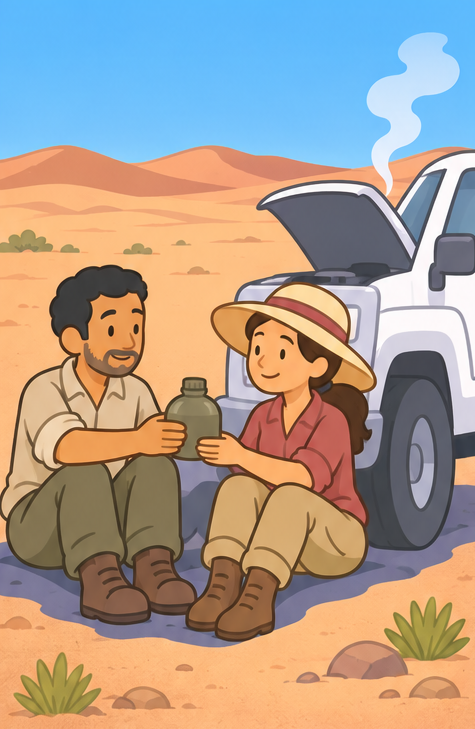
The truck gave up at eleven in the morning, forty kilometers from the nearest town. Samir lifted the hood and was met by a cloud of white steam. "The radiator," he said, closing it slowly. "It's dead." Dalia, his colleague, looked at the map, then at the sky, which was a hard, empty blue. They had been surveying for a mining company for two weeks, and nobody would start to worry before Friday.
They checked their supplies. There were four liters of water, half a bag of dates, a blanket, and a flashlight. No radio worked out here, and the phones had lost their signal an hour earlier. "The rule is to stay with the vehicle," said Dalia. "Rescuers look for vehicles, not for people." Samir agreed, though his face was tense. "But if nobody comes?" "Then we walk," she said. "After sunset."
They spent the afternoon in the small shadow of the truck, without talking, drinking in small sips. The heat was merciless, and the ground was so hot that it burned through the soles of their boots. By six, the sun had sunk low and the sand had turned orange. They had one liter left. "It's time," said Dalia.
They walked all night, following a dry riverbed that the map showed going toward the town. The night turned bitterly cold, and the stars were so numerous that it almost hurt to look at them. At two in the morning, Samir tripped and fell. Getting up, he noticed something odd: a small pile of flat stones on the ground, stacked carefully, one on top of the other. A few meters further on, there was another.
"Somebody put these here," he said. "They've been arranged in a line." Dalia knelt beside the stones and ran her fingers over them. "Desert guides make them," she said. "Old ones. They mark the way to something." They exchanged a look; neither of them dared to hope too much. Slowly, they began to follow the stones.
The line curved away from the riverbed and led them up a low ridge. At the top, in a hollow between two rocks, there was a circle of stones about the size of a table. In the middle was a rusty iron cover with a rope attached to it. Samir pulled the cover aside and shone the flashlight down. Far below, the light flashed on the surface of water.
They spent an hour lowering a bucket that they found tied to the rope. The water was cold and tasted of iron, and it was the best thing either of them had ever drunk. At dawn, with the sun coming up red over the ridge, Dalia filled the last canteen to the top and held it up to the light. "Now," she said, smiling for the first time in a day, "we can walk."