 Entrar

The Hitchhiker Who Knew Too Much
El autoestopista que sabía demasiado · B2 · Suspenso · 5 min
The Hitchhiker Who Knew Too Much
El autoestopista que sabía demasiado · B2 · Suspenso · 5 min
Ejercicios
Toca cualquier palabra para ver qué significa. En negrita, las de esta lectura. Con el teclado: flechas para moverte y Enter para abrir.
At four in the morning, the highway was completely deserted. Nora had been driving for three hours, mostly because she could not sleep. Two days earlier, she had buried her father, and the house had felt unbearably quiet. So she had taken the car and followed the road he used to patrol every night, toward mile marker 40, where his tow truck had always waited for calls.
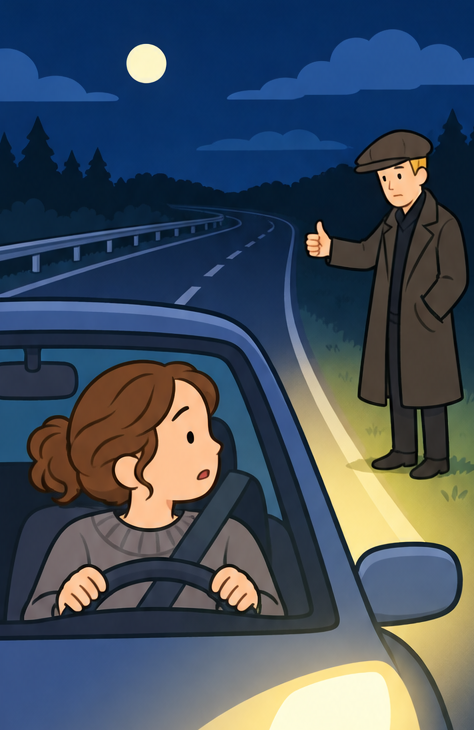
Her headlights caught a figure at the side of the road: a thin man in a long coat, holding up one thumb. Never in her life had Nora picked up a hitchhiker. Yet she hesitated, and her foot found the brake before she had made up her mind. "Car trouble?" she asked through the window. "Something like that," he said. "I'm Elias. Could you take me a few miles down the road?"
He climbed in without a bag, and for a while neither of them spoke. The heater hummed, and the radio flickered between a weak station and static. Then Elias said, without turning his head, "You shouldn't blame yourself for not being there, Nora." Her mouth went dry. She had not told him her name.
"How do you know my name?" she asked. He said her father had often talked about her. She replied that her father, who had driven a tow truck for thirty years, had spoken to hundreds of drivers, and that he would never have described his daughter to a stranger. "He told me that you still sing the wrong words to the old song on the radio," Elias replied gently. Nora laughed before she could stop herself, because it was true, and then she stopped laughing.
She asked him where they had met. He explained that her father had once towed his car in the middle of a blizzard and had refused to take any money. "He said the road took enough from people already." Those had been her father's exact words, the ones he repeated every winter. Not once had he said them in front of anyone outside the family. Nora tightened her grip on the wheel, and a cold, uneasy feeling settled in her stomach.
"Here is fine," Elias said suddenly. Nora glanced at the odometer, then at the marker flashing past her window. Mile 40. Nowhere was there a house or a light, only tall grass bending in the wind. She pulled onto the shoulder. "Are you sure?" she asked. "There's nothing here." He smiled. "He told me you would stop. He said you would be kind." Then he stepped out, closed the door softly, and walked into the dark.
Nora stayed where she was, with the engine running. After a minute, she noticed something on the passenger seat: a small metal keyring with the name of her father's towing company on it. He had carried it for thirty years. Two days earlier, she had slipped it into his coffin, just before the lid was closed. Hardly daring to breathe, she picked it up with two fingers. It was still warm.
When she finally looked up, the road ahead was empty, and so was the road behind. She sat very still, holding the keyring, and asked herself the one question she was afraid to answer: had he really been a stranger, how could he have known to ask for mile 40?