 Entrar

The House on Maple Street
La casa de la calle Maple · B2 · Drama familiar · 4 min
The House on Maple Street
La casa de la calle Maple · B2 · Drama familiar · 4 min
Ejercicios
Toca cualquier palabra para ver qué significa. En negrita, las de esta lectura. Con el teclado: flechas para moverte y Enter para abrir.
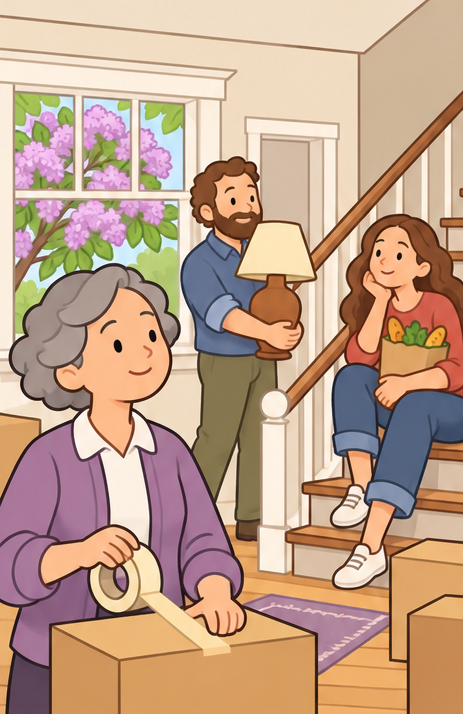
In the last week before the sale, the three siblings met at their late mother's house to empty it. It was mid-April, and the lilac in the front garden was blooming with almost indecent cheerfulness, as if nothing had changed. Andrea, the eldest, had brought labels and a roll of tape. Luis had brought a truck. Tere, the youngest, had brought nothing except a grocery bag, and she sat on the stairs with her chin on her knees.
They had already argued about the sale twice. Luis wanted to keep the house. "If we kept it, we could rent it," he said, "and in ten years we'd have something of hers." Andrea, who was practical, shook her head. "Were we to keep it, who would pay for the roof? And who would look after the garden? You live in another city, Luis, and Tere is barely home." Nobody answered, since nobody could honestly say she was wrong.
They worked in silence for most of the morning: books for the library, blankets for the shelter, and the good plates for Andrea's daughter. Each box had a label, and the labels looked strangely like a verdict. At noon, Luis opened the kitchen cupboard and found forty years of coupons, rubber bands, and mismatched lids. He laughed at first, then leaned on the counter and stayed there, motionless, for a long time.
Later, in the kitchen, Tere noticed something she had never looked at properly. On the door frame, there were pencil marks, with dates and names: "Andrea, 1989, age 6. Luis, 1991, age 7. Tere, 1995, age 5." Every birthday, their mother had insisted that they stand straight against the wood, a book balanced on each head. The marks rose up the frame like a tiny ladder. "We can't take the door," said Andrea softly. "We could try," said Luis.
In the end, they took photographs instead, capturing each line and each date. Then all three stood against the frame, their backs straight and a book on their heads, while a neighbor, who had come to say goodbye, took a picture on Luis's phone. They were far taller than the marks, and not one of them could say why that made them want to cry.
Before they left, each one chose something small. Andrea took the old radio that had always been playing in the kitchen. Luis took their mother's camera, with a half-used roll of film still inside. Tere took the green watering can, which she had used as a little girl to water a garden that was now too small for her.
Andrea locked the front door for the last time. The key was heavier than she remembered. From the gate, Tere looked back at the lilac, and at the window of the kitchen, and at the place where their lives had been measured in pencil. "It's just a house," she said quietly. "I know," said Luis, and none of them moved for a long while.